Exposure

songwriting contest entry 

Connect to us:

 email

Email Subscribe

Your email:

Browse by Tag

Songwriting Tips, News & More

Current Articles | RSS Feed RSS Feed

Songwriting Tip: Striking the Right Chord


STRIKING THE RIGHT CHORD

 Danny Arena, songwriter

By Danny Arena

One kind of "creative rut" that songwriters can easily fall into is when the chorus section of all their songs starts to sound the same. Some songwriters get into the habit of using the same chord to begin the chorus of every song they write. In one of my SongU.com courses, we look at some of the many chords you can use to start your chorus as well as some of the successful songs that have used them in the past.


The I (ONE) CHORD

Contrary to popular belief, there's nothing wrong with starting the chorus to your song (or bridge in an AABA song) on the "I" chord. Be careful though, to make sure your chorus contrasts from the verse - either rhythmically or melodically. For example, both the chorus and verse to hit song "She Believes In Me" (songwriter - Gibb) begin on the I chord, but the melody soars high in the chorus in contrast to the melody in the verse. Similarly both the verse and bridge to song "Somewhere Over The Rainbow" (songwriter - Howard/Arlen) start on the I chord, but the 8th note rhythm of the bridge makes it stand out in contrast to the half note feel of the verse. The Bruno Mars hit, “Just The Way You Are” takes the opposite approach and the rhythm in the chorus contains longer notes than the verse even though both sections start on the I chord.


THE iim (TWO MINOR) CHORD

The iim chord is similar in structure to the IV chord, but, like the iiim and vim chord, it is a minor chord with a different sound quality than the IV chord. It is not used very frequently to begin a chorus, but is used more often as a starting chord of a bridge section in an AABA song as in the old standard "I'm In The Mood For Love" (songwriter - Fields/McHugh).


THE iiim (THREE MINOR) CHORD

Another chord which is similar in structure to the I chord is the iiim chord. It is not used as frequently to start a chorus as the vim chord but has a similar sound quality. The Beth Neilson Chapman adult contemporary hit, "All I Have" (songwriter - Chapman/Kaz) has a chorus which starts on the iiim chord, and the bridge of the Elvis Presley AABA classic, "Can't Help Falling In Love" (songwriter - Weiss/Peretti/Creatore) starts on a iiim.


THE IV (FOUR MAJOR) CHORD

Another common chord choice for starting the bridge or chorus of a song is the IV chord. Probably the reason it is such a popular choice among songwriters is because of it can be set-up easily. By ending a verse on the I chord, you automatically have set up the chorus to begin on the IV chord. This is because of the natural "pull" the I chord has toward the IV chord (technically speaking, the I chord acts as the dominant of the IV chord). Some of the many songs which use the IV chord to start the chorus (or bridge), include the Kenny Rogers classic: "Lucille" (songwriter - Bowling), the Christina Aguilera ballad, “Beautiful” and the Train hit, “Hey Soul Sister”.


THE V (FIVE MAJOR) CHORD

A common chord used to begin a chorus in a song is the V chord. The V chord is a naturally unstable chord and the I chord is a naturally stable chord. So when you end the verse on the I chord and start the chorus on the V chord, you create a contrast. The chorus in the Reba McEntire classic, "Rumor Has It" (songwriter - Burch/Dant/Shell) starts on the V chord.


THE viim (SIX MINOR) CHORD

The vim chord is a chord which is fairly close in structure to the I chord. In fact, two of the three notes that make up these two chords are the same. The one note difference between these two chords results in the vim chord having a more "somber" quality as opposed to the "brightness" of the I chord. Starting the bridge on the vim chord can result in a change of mood in a song as in, "Through The Eyes Of Love" (songwriter - Hamlisch/Sager) or "What I Did For Love" (songwriter - Hamlisch). The Grammy winning song, "Wind Beneath My Wings" (songwriter - Henley/Silbar) begins its soaring chorus on a vim chord as does the chorus in the Taylor Swift hit, “I Knew You Were Trouble.”

So that gives you six different approaches you can try the next time you're looking for a different sound for that chorus you're writing. Maybe one of them will spark something in you that will help you create a standout chorus.

Hope to see you on the charts.


About Danny Arena
Danny Arena is a Tony Award nominated composer and professional songwriter. He holds degrees from Rutgers University in both computer science and music composition, and serves as an Associate Professor at Volunteer State Community College in Nashville, and an adjunct member of the faculty at Vanderbilt University. In addition, he has been invited to teach songwriting workshops throughout the U.S. and abroad, and performs his original songs regularly in Nashville at venues like the Bluebird Café. As a staff songwriter for Curb Magnatone Music Publishing, he composed several songs for the musical "Urban Cowboy" which opened on Broadway in March 2003 and was nominated for an Outer Critics Circle Award for Best Musical and a Tony Award for Best Original Score. He is also the co-founder, CEO, and one of the main site developers of www.SongU.com, which provides over 100 multi-level courses developed by award-winning songwriters in addition to online coaching, co-writing, industry connections, and pitching opportunities.

For more information on the 18th Annual USA Songwriting Competition, please go to: http://www.songwriting.net


Songwriting Tip: A Demo A Day


Songwriting Tip: A Demo A Day


A successful songwriter gets you creative in a hurry 

By Joe Bouchard

Songwriting Tip: A Demo A Day


When many of the great rock songs were written in the ’60s, writers would hack out a song in an hour or two. For example, “A Hard Day’s Night” was written by John Lennon overnight. The next morning it was done and ready to record in a few hours.

I’m very happy with the songs I’m doing these days. The biggest change to my working style in the last three years has been my “Demo in a Day” habit I’ve gotten into. It goes like this:


1. Start with a great hit song.


2. If you can’t find a hit song in your bag, use any song sketch that you’ve got. Or cover somebody else’s song. You’ll learn if you force yourself to dig, and be creative. Remember—even the great songwriters write a stinker sometimes, but keep pushing.


3. Get a good computer (Mac is my preference, but many successful writers make brilliant music on PCs too) and sequencer/DAW program. Learn the programs thoroughly. If you are having a problem with a program, look up a solution on YouTube. Chances are some geek has posted an answer, and can show you how things work without reading the manual.


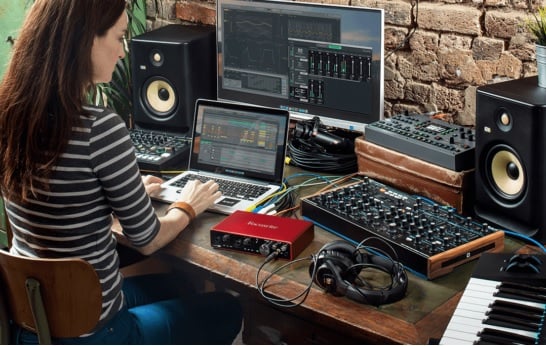
You don’t need a lot of fancy hardware. I use only two mics for demos, an SM57 for guitars and a RØDE condenser for vocals. Most everything can be done with a direct box, or with plug-ins in the sequencer. My recording program is MOTU Digital Performer, I’ve been using it for years; occasionally I’ll use Pro Tools, and have started using Logic too.


4. Demo the song. Work quickly.


Morning


Get up early. Shut off all emails, Facebooks, don’t answer the phone—let the answering machine pick up all calls. Don’t watch the morning news, or check the weather. Make coffee.


First, record a Guide Demo to a click if you can—mono or stereo, it doesn’t matter— with just simple piano chords, or acoustic guitar chords. Don’t be fussy. Just throw an open mic in the room and wail away. Don’t fix any wrong notes or out-oftuneness, the cruder the better. This Guide Demo will force you to stay focused to get you to the finished “Demo in a Day”.


Put the Guide Demo in the top track of your sequencer. You will be turning this on and off as you work on your “Demo in a Day”.


Add markers at the top of your sequencer that mark the intro, verses, choruses, any bridge, and the ending.


Now do a rough drum track. I use Toontrack Superior Drummer; the sounds are very realistic and I have hundreds of MIDI drum files that give me any style I might want. I even bought other drum MIDI files from a company called Groove Monkee. They all work seamlessly with Digital Performer. Making drum parts is only a matter of drag and drop from the Groove section of the plugin to a MIDI track that is assigned to the Superior Drummer instrument.


Use markers to vary the drum parts as a real drummer would. Add fills either a bar or two bars before each new section. It’s easy to see on the screen when a new section is coming. Usually the drum feel is the hardest to nail, so try different parts until you are happy with the feel and how it expresses the feeling in the Guide Demo. Be patient, this could take up most of your morning.


Break for lunch when you’ve got the drum part programmed.


Noon


Right after lunch start recording rhythm guitars. The goal is to have a finished song by the end of the day, so you can’t get too fussy with sounds. I often use a Line 6 POD for guitar. It’s fast and it works. The sounds are very mixable. Even Pete Townshend admits to using one in a pinch. Next do piano parts or other coloration


parts. Percussion can help too. Bass parts you can do last, or first—it’s up to you. Don’t spend a lot of time on fixing little things. Loop a part if you stumble in the 2nd verse, or 2nd chorus.


Doubling parts will make it sound like a classic rock song. I don’t double with copy and paste and time shift, I prefer to actually play the same part twice and pan them L and R. It sounds like the way music was made in the late ’60s and early ’70s. [See this month’s Talkback for hints on creating doubled parts quickly—Ed.]


Sing a rough vocal. Add harmonies. Double the harmonies. Replace the rough vocal with a better vocal. I don’t like Auto- Tune, but I might use the tiniest amount on a rough spot.


All the time I am recording, I’m reaching for plug-ins that do my eq, compression, and reverb. If I need to automate part of the mix, I’m doing that as I’m recording.


And night


Break for dinner. After dinner, mix it down. It shouldn’t take too long to get something reasonable, since you’ve already set up eq and compression as you were recording. When you get a mix, load in onto your MP3 player. Take a short drive in your car and test the mix. I always do the “car test” for mixes. Remix until satisfied.


By now it’s about 10 PM. Do you know where your song is? It should be mixed and presentable to your friends, relatives and the rest of the band.


I’ve spent months working on certain song demos. In the end, with that style of recording the results are mixed at best. The “Demo in a Day” technique works better. By forcing yourself to work quickly it’s easier to keep zeroed in on the emotional focus of your song.


By the end of the day you will hear whether the song is going to be great or not. If it isn’t, don’t sweat it, you’ve only invested one day of your time; tomorrow you can go on to a new song. The perfect song is waiting around the corner.


Joe Bouchard is a singer, songwriter, and bass player who has worked with his brother Al in bands like Blue Öyster Cult— he was first interviewed in our October 2011 issue. To learn more about his music, visit www.bluecoupeband.com.


Excerpted from the March edition of Recording Magazine 2012.   ©2012 Music Maker Publications, Inc. Reprinted with permission. 5408 Idylwild Trail, Boulder, CO80301 Tel: (303) 516-9118 Fax: (303) 516-9119 For Subscription Information, call: 1-800-582-8326 or www.recordingmag.com  For more information on the 17th Annual USA Songwriting Competition, please go to: http://www.songwriting.net


All Posts